
Who Trains the Biggest AI Models? Labs, Countries and the Cost of a Training Run
AlexNet, the image classifier that won the 2012 ImageNet contest, cost about $16 to train in 2023 dollars, by Epoch AI’s estimate. At the top of Epoch’s list sit three runs from 2025: Grok 4 at about $390 million, GPT-4.5 at about $370 million and Grok 3 at about $220 million. Grok 4’s figure is roughly 25 million times AlexNet’s.
We will not name the most expensive of the three. They are within a factor of two of each other, and the compute estimates behind them are rated Speculative for Grok 4 and Likely for the other two, which allows errors far larger than that gap.
Epoch’s field, “Training compute cost (2023 USD)”, is estimated with what its documentation calls the “amortized hardware capex plus energy” approach. In its cost methodology, the hardware share is the chip-hours of the run multiplied by a depreciated price for the chips, servers and networking, and the energy share is the electricity the hardware used. Both cover only the final training run. Researchers’ salaries, the experiments and abandoned runs that come before, and the price of buying the cluster outright are all left out, so the figure understates what a model costs to develop.
From universities to companies
Epoch tags each organization as industry, academia, a research collective or government; where a model lists several, we count only the first.
Among models with a compute estimate, universities led the early deep learning years. From 2010 to 2017, 56 of 89 models, or 63 percent, were first-listed to academia and 33 to industry. From 2018 on the balance flips: industry leads 296 of 389, or 76 percent, against 84 for academia, 7 for research collectives and 2 for governments. Counting any industry partner rather than only the first, 333 of the 389 involve a company.
Who holds the top places
We ranked every model by its compute estimate and took the top 25. The cut is somewhat arbitrary: 25th place, Reka Core at 8.4 × 10²⁴ FLOP, is only 5 percent above the 26th, Inflection-2.5 at 8.0 × 10²⁴.
All 25 were published in 2023 or later. By organization, OpenAI has five, xAI three, and Anthropic, Cursor and Meta two each. Eleven others have one: Alibaba, ByteDance, DeepSeek, Google DeepMind, Huawei, Inflection AI, Meituan, Moonshot, Nvidia, Reka AI and Saudi Aramco. By country, 18 are from the United States, 6 from China and 1, Aramco’s Metabrain AI, from Saudi Arabia. None of the 25 lists more than one organization, so the first-listed rule changes nothing here.
Cursor’s two Composer models are built on Moonshot’s open Kimi K2.5, so a Chinese base model sits under two American entries. And Google appears only once because Gemini 1.0 Ultra is the only Gemini model in the file with a compute estimate.
Across all 172 models since 2023 with a compute estimate, the United States has 89 (52 percent), China 62 (36 percent) and South Korea 11 (6 percent). Saudi Arabia, the United Arab Emirates and the United Kingdom have two each, and France, Germany, Japan and the Netherlands one each. Here the first-listed rule does matter a little: 21 of the 172 name organizations in more than one country.
What a run costs
Only 180 of Epoch’s 1,072 notable models have a cost estimate. The chart shows all of them, with hollow circles for records that Epoch rates Speculative.
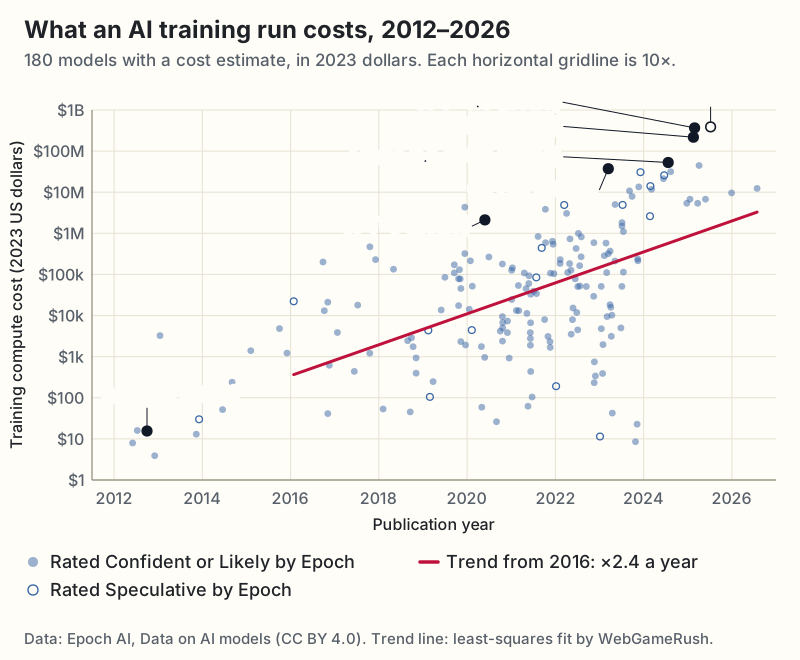
A least-squares line through the logarithm of cost against publication date, for the 168 models from 2016 on, rises about 2.4 times per year, a doubling roughly every ten months. The fit is loose: it explains about 24 percent of the variation, because the sample mixes frontier runs with small ones, 25 of them under $1,000, from companies as well as universities.
Epoch’s own numbers land in the same place, from a different sample. The rising costs of training frontier AI models, a 2024 paper by Ben Cottier and colleagues, reports growth of “2.4x per year since 2016 (90% CI: 2.0x to 2.9x)” in its current version; the first version, and the text of Epoch’s summary, still give a 95 percent interval of 2.0 to 3.1. Its sample is frontier models, which Epoch’s summary describes as those in the top 10 by training compute when they were released. Epoch’s data insight Training compute costs are doubling every eight months for the largest AI models also puts the growth of spending on large-scale models at 2.4 times per year (its headline’s eight months is faster than 2.4 times a year implies, which works out to about nine and a half). Ours covers every notable model with a cost estimate, so the match is partly luck. The line tracks the typical notable model; a fit on the 44 frontier-flagged models from 2016 with a cost is steeper, about 2.9 times a year, and 43 of the 44 sit above the all-model line.
The same data can split growth into spending and efficiency. For the 166 models from 2016 on that have both a cost and a compute estimate, cost grows about 2.3 times a year, compute about 3.3 times, and compute bought per dollar about 1.4 times. On a log scale the first and third add up to the second, so, measured in orders of magnitude, about 70 percent of the growth in these models’ compute came from spending more and about 30 percent from getting more compute per dollar. That matches the finding we noted in our look at training compute: Epoch attributes most of the growth to bigger budgets rather than better hardware.
What they train on
Of the 172 models since 2023 with a compute estimate, 105 name their training hardware, and 4 of those name more than one chip. We count a model once for each chip it lists.
NVIDIA’s A100, which the file lists under three names, appears in 37 models. The H100 SXM5 appears in 25, Google’s TPU v4 and NVIDIA’s V100 in 8 each, and NVIDIA’s H800, a version of the H100 made for the Chinese market, in 5. Overall, 87 of the 105 list at least one NVIDIA chip, 13 list a Google TPU and 3 list a Huawei Ascend.
The A100’s lead is a 2023 effect. All 37 A100 models were published in 2023 or 2024, while 24 of the 25 H100 models came out in 2024 or later. Models from 2023 make up 54 of the 105, partly because hardware is listed far more often for them: 54 of 65, against 15 of 40 in 2025. Of the 20 Chinese-led models that list hardware, 5 name the H800 and 3 name an Ascend.
What the numbers leave out
- First-listed only. Organization type and country use the first entry in each field.
- Who gets a cost estimate. Most of the 180 are from 2019 to 2023 (131 models); only 17 were published in 2024 or later. 164 of the 180 name their training hardware, which the method needs, and 139 were led by industry. Of the 124 models the file flags as frontier (top 5 by compute at release, a stricter cut than the paper’s top 10), 56 have a cost. GPT-6 Astra, the largest by compute, has none.
- Every figure is an estimate. Epoch’s confidence labels apply to the compute, parameter and dataset figures, not to the dollar amounts. In Epoch’s words, ‘Confident’ records are ‘accurate within a factor of 3x’, Likely within 10x and Speculative within 30x. The cost adds its own assumptions about chip prices and depreciation.
- Notable is Epoch’s choice. The file is Epoch’s list of notable models, chosen for things like state-of-the-art results, heavy citation, wide use or historical importance. It is not every model trained, and plenty of large runs never publish enough to be estimated.
Data and method
We used Epoch AI’s Data on AI models (CC BY 4.0), the notable-models file downloaded on 28 September 2026, the same snapshot as our compute post: 1,072 models, 540 with a compute estimate and 180 with a cost. Trends are ordinary least-squares fits of the base-10 logarithm against publication date as a decimal year. Dates are publication dates, not the end of training. Figures are from the notable-models file and can differ from those on Epoch’s other pages.
Where to go next
Our earlier post on training compute covers the other axis of this data. To test your sense of scale, Scale Guess asks each day which of two famous models used more training compute.