About Pixel Trace
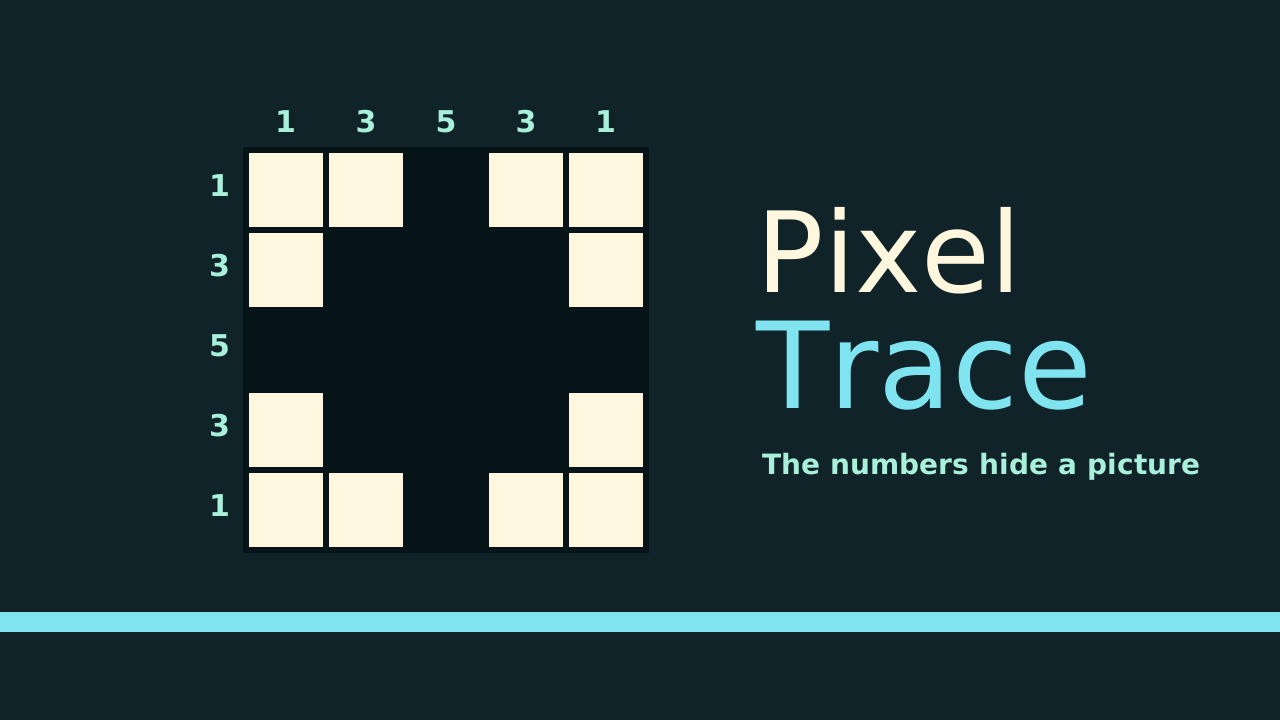
Nothing is hidden from you in Pixel Trace. The numbers beside each row and above each column state exactly how many filled squares sit in that line and in what order the blocks appear — a row marked 3 has one unbroken run of three, while 1 1 has two single squares with at least one gap between them. Everything you need is on screen from the first second; the work is entirely deduction.
The boards we ship are hand-drawn on five-by-five and six-by-six grids, small enough to finish in a coffee break and large enough that guessing will not save you. A new one arrives daily.
How to play
- Read a line’s clue and work out which squares must be filled in every valid arrangement.
- Fill those squares, and cross off the ones you have ruled out.
- Use the newly known squares to constrain the crossing lines, and repeat until the picture resolves.
Controls
- Left click or tap a square to fill it; click again to empty it.
- Right click to pencil in a cross, marking a square you have proved is empty.
- Check highlights any square that does not match the solution.
- Clear wipes the board back to blank.
Tips
- Start with the largest numbers. On a five-wide grid, a clue of
5fills the line outright and a clue of4guarantees the middle three squares whichever way it slides. - Crosses are not decoration. Marking what is definitely empty is usually what unlocks the next filled square.
- A line whose runs plus the mandatory single-square gaps exactly equal the grid width has only one arrangement — solve those first.
- When a line stalls, move to its crossings rather than guessing. Every board here is solvable by pure logic.